P1-visual / static-world variant — only agent-side modulation
experiments/p1v_static_world.py
This experiment isolates the multi-CAZ eye's reafference register by holding the world genuinely still (or nearly so), so the only motion the modulator ever has to predict is the eye's own. The three conditions share the same body, same eye-saccade schedule, same modulator — only the cylinder's behaviour differs.
The three conditions
| calibration | self-test | exafference | |
|---|---|---|---|
| A. always-static cylinder | cylinder visible-static | cylinder visible-static | cylinder visible-static |
| B. visible → oscillating | cylinder visible-static | cylinder visible-static | cylinder oscillates around the same position |
| C. hidden → visible-static | cylinder hidden (behind +x wall) | cylinder hidden | cylinder appears at the position and stays static |
In all three conditions, the head is held at 0 (no body CAZ activity); the
eye saccades with random fixation targets in [−15°, +15°] every 0.35 s; the
camera is mounted on the eye; the analytical predictor uses the eye's own
Δθ with the sec²(α) per-column correction; the modulator's per-patch
floor is the p90 of calibration residual magnitudes (clipped at 3.0).
Result
A. cylinder visible-static throughout             : selftest fire = 0.000   exaf fire = 0.000   ×0.0
B. visible-static → oscillating during exafference: selftest fire = 0.000   exaf fire = 0.029   ×28.8
C. hidden → visible-static during exafference     : selftest fire = 0.000   exaf fire = 0.025   ×25.0
Result & interpretation
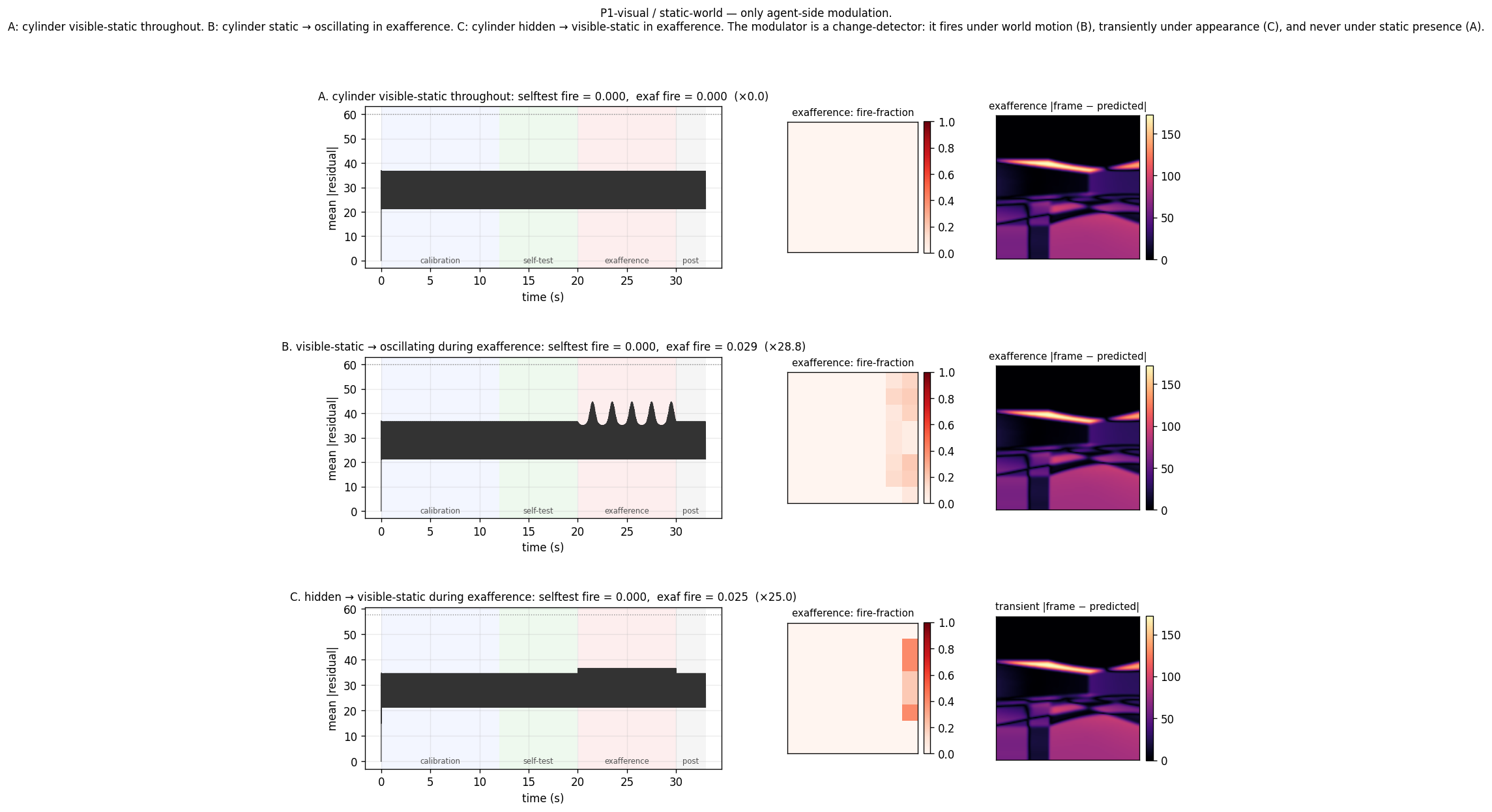
Three rows, one condition per row. Per row, left to right: mean per-patch
|residual| time-series with the four phases shaded; the exafference
fire-fraction heatmap; and a representative |frame − predicted| frame
(transient for C; steady-state for A and B). Row A's residual is flat across
all phases with only periodic saccade transients; its fire heatmap is empty.
Row B's residual oscillates strongly during exafference with the cylinder's
motion. Row C's residual is elevated during exafference (starting with a
sharp appearance transient and then settling to a sustained baseline above
self-test).
What condition A shows — the user's predicted finding
Condition A is silent throughout. The cylinder is part of the world from
t = 0; the modulator's floor is calibrated with the cylinder in view; the
eye's saccades are perfectly predicted by Δθ_eye · focal_px · sec²(α); the
warped previous frame matches the current frame to within the floor at every
patch. No patch fires in calibration, none fires in self-test, none fires
in "exafference" either — because nothing about the world is changing.
This is the cleanest possible statement of the architectural claim: when only the agent is moving and the predictor knows what's there, the snapshot receives nothing. The modulator's silence is the architecture working as designed, not a bug.
What B shows — motion against a known scene
The cylinder is visible-static during calibration; the modulator's floor at the cylinder's patches accounts for the cylinder's own edges under saccade. When the cylinder starts oscillating in the exafference window, the motion is the world-caused change the modulator catches. Fire-fraction rises sharply (×28.8 over self-test), concentrated on the patches the cylinder sweeps through.
What C shows — and the deeper finding about floor-as-memory
The naive prediction was that condition C would fire only as an appearance transient (one frame when the cylinder teleports in, then silent — because the analytical predictor has no explicit memory of the pre-cylinder world). That prediction was wrong, in an architecturally informative way.
What actually happens: the cylinder's appearance produces a sharp transient spike, and then the residual settles to a sustained elevated baseline for the rest of the exafference window — almost as much firing as condition B's moving cylinder.
The mechanism is the per-patch floor calibration. In condition C, the cylinder is hidden during calibration; the floor at the patches where the cylinder will later appear is calibrated against wall + floor-texture content only. When the cylinder is present during exafference, its silhouette contributes residual at every saccade — not because anything is moving in the world, but because the sub-pixel warp on the cylinder's sharp edges generates a small residual at each saccade, and this residual exceeds the floor that was calibrated without those edges. Every saccade renews the fire.
This reveals that the modulator's per-patch floor calibration is the architecture's first-order "scene memory". The modulator catches anything that differs from calibration:
- motion (B),
- appearance (C-transient),
- persistent presence whose edges the floor wasn't calibrated against (C-sustained).
The contrast between A and C is the cleanest expression: same scene, same agent motion, same modulator — only the calibration content differs. In A the floor "knows" the cylinder and stays silent under it; in C the floor doesn't, and fires on it. Memory of the scene lives in the calibration.
What this experiment shows (and does not)
It does say:
- Only agent-side modulation produces no snapshot input. Condition A is literally silent across all phases — the closed loop "no modulation, no input" runs even when the world is static. The agent's BAP-and-eye motion generates no perception when there is nothing in the world to surprise it.
- The modulator catches departures from calibration, of any kind — motion (B), novel appearance (C-transient), or novel persistent content whose noise statistics weren't in the calibration distribution (C-sustained).
- Floor calibration is implicit scene memory. The architecture has a real, first-order form of "what's expected here" — not as a learned forward model, not as an explicit map, but as the per-patch residual distribution the modulator built up during calibration. Departures from that distribution are what the snapshot sees.
It does not say:
- That the architecture has persistent memory beyond the calibration
window. The floor is frozen once
finalize()is called; the modulator does not update it during self-test or exafference. A truly novel object that appeared and stayed forever would keep firing forever — there is no habituation mechanism. (Adding one — a slowly updating floor that re-learns the scene — is a natural successor experiment.) - That the calibration floor can distinguish "moving cylinder" from "static novel cylinder" by signal magnitude alone. Conditions B and C have comparable exafference fire-fractions (×28.8 vs ×25.0); the spatial pattern and temporal structure would distinguish them (B is sustained across cylinder's swept positions; C has a sharp transient + steady baseline at a single position), but the scalar fire-fraction does not.
- Anything about depth or about a learned forward model. The predictor is still analytical; the "memory" demonstrated here is purely the floor's shape, not a model of how the world evolves.
What it adds to the assumptions
Common assumptions hold, plus the
P1-visual ones — same multi-CAZ eye, same predictor with the
sec²(α) correction, same modulator. This experiment adds:
- The world's behaviour during the exafference window is the experimental variable — three discrete choices: same-as-calibration, oscillating around the same position, or appearing-from-hidden.
- The modulator's floor is explicitly understood as scene memory (the per-patch residual distribution calibrated against the calibration scene), and the experiment's conditions exercise it directly.
What is not added: a habituation mechanism (the floor stays frozen after calibration); a snapshot accumulator that integrates fires into a persistent map; an explicit learned forward model. These are the natural next pieces of architecture this experiment motivates.
Why this experiment is in the bench
It pins down the modulator's discrimination boundary at the cleanest possible operating point: only the agent moves. Condition A is the bench's first negative result demonstrating that the architecture's silence under pure self-motion is real and complete, not a hidden source of noise. Condition B reproduces the standard exafference detection under known-scene conditions. Condition C reveals — as a finding, not a planned demonstration — that the modulator's floor calibration already encodes a primitive form of scene memory, and that "novel persistent presence" is detected through the same mechanism as "novel motion," modulated by the calibration history rather than by an explicit world model.
Together the three conditions read as the architecture's first careful statement of what counts as a sensation the snapshot must absorb: any patch-level residual that the calibration didn't account for, by any mechanism.
Run it
cd experiments && ../.venv/bin/python p1v_static_world.py
Outputs: figures/p1v_static_world.png. Runtime: ~70 s on a laptop CPU.