P2 — Basal coupling: why a cognizing agent moves
experiments/p2_basal_coupling.py
The first telling simulation of the bench. The previous P2 experiments asked can the agent build a faithful picture of its world?; this one asks the prior question: why does it move at all?
The answer is constructive, not designed. Movement is encoded as a biological necessity, and the cognitive substrate (the living-snapshot map) is what closes the loop:
The BAP needs energy. Energy depletes with movement. Energy is replenished only by food, which is in the world. The map of the world fades where it is not revisited. So — no movement, no live map; no food, no energy; no energy, no BAP; no BAP, no movement.
The same closed loop, taken through the body, is why an organism moves and why the cognitive substrate is inseparable from biology. The simulation lets the loop run and watches what happens.
Setup
Same body, balance beam, locomotion, dead-reckoning, and living-snapshot map as P2 — living snapshot. New is a biological state the agent carries:
| variable | role |
|---|---|
energy ∈ [0, 100] |
a single scalar reserve |
E_basal = 0.5/s |
drain at rest (a baseline metabolism) |
E_move = 1.5/s · |drive| |
additional drain proportional to BAP output |
E_food = 25 |
gain on body contact with a food item |
E_crit_low = 5, E_crit_hi = 20 |
BAP weakens linearly between these; fails at or below 5 |
The BAP drive itself is gated by the reserve — forward = bap·gate·energy_gate(E)
— so as energy falls toward the floor, the drive smoothly weakens and the agent
stops. At E = 0 the gate is zero and the agent halts permanently: death.
Food is eight point items scattered through the arena, not in the MJCF model.
They are tracked in Python and consumed on body contact (distance < R_eat = 0.13
m). A consumed item regrows at its source after T_regrow = 30 s — the world is
an ecosystem, not a larder. The map decays at 0.1/s (a moderate living snapshot).
Conditions
| condition | what differs |
|---|---|
| A — no food | the world has no food items |
| B — with food | eight food items, regrowing 30 s after consumption |
Everything else is held fixed (same seed, same body, same arena, same map decay). The only thing that changes is whether the world offers nourishment.
Result
no food  : died at t = 119.5 s   (final energy = 0)
with food: alive,  consumption events = 19,  final energy = 98.7
The contrast is the experiment's whole point:
- A — no food. Energy decays monotonically; the BAP gate falls below 1 around E ≤ 20 and the agent slows; it dies at t ≈ 120 s. The map it built is sparse — it never circulated long enough to develop one.
- B — with food + regrowth. Energy traces a characteristic sawtooth — drain,
contact, refill near
E_max, drain — and the agent is alive att = 180 swith 19 consumption events. The same body, kept alive long enough, produces a visibly richer live map of the arena.
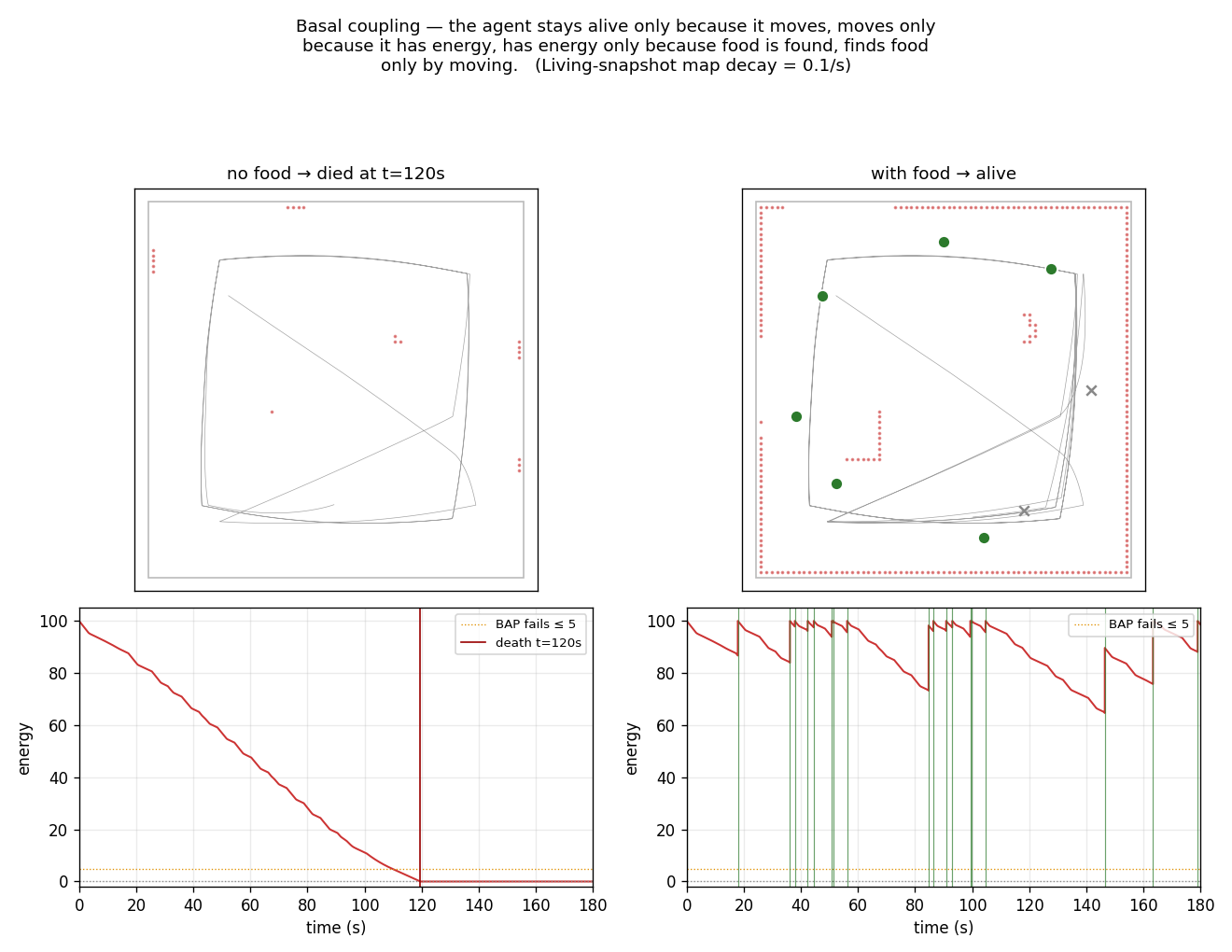
Top row per condition: trajectory + arena + food (green = available, gray × = eaten) + live map. Bottom row: energy time-series with consumption (green) and death (red) markers. Same agent in both columns — only the world differs.
The map quality in the with-food panel is not a separate finding — it is the same finding seen from the cognitive side. The agent has a more developed picture of its world because it stayed alive long enough to keep moving. Cognition is sustained by biology; biology is sustained by what cognition makes findable. This is what "basal coupling" names.
What this experiment says (and does not)
It does say:
- A minimal cognizing agent built from the SMN primitives stays alive only because the loop closes through the body and through the world. Remove any link (BAP, energy, food, movement) and the loop opens — and the agent dies.
- The cognitive substrate (the living-snapshot map) is not optional decoration on top of biology. In B, it is built precisely because the agent could afford to keep moving; in A, it cannot be built because the agent runs out before it can map.
It does not say:
- That the agent is navigating to remembered food. In this experiment, food acquisition is by random body contact during the exploration the HAP drives (it follows open whiskers and avoids walls). The next refinement is to let the HAP read the live map and steer toward remembered food — at which point map decay becomes a direct survival pressure, not only a perceptual one.
What it adds to the assumptions
Common assumptions hold (planar rigid-body world; rangefinder "whiskers"; etc.). This experiment adds these idealizations:
- The agent carries a single scalar energy reserve, depleted by drive and a basal cost and replenished only by food contact.
- The BAP is energy-gated by a piecewise-linear ramp
[5, 20]; at zero the drive is zero ("death") and is irreversible within a run. - Food is a list of point items in Python state (not MJCF geoms); consumption
is a body-frame proximity check. Each item regrows at its source after
a fixed delay (
T_regrow = 30 s) — the simplest model of a renewable resource. - The map is a living snapshot (decay 0.1/s) as in P2 — living snapshot.
What is not modelled: an explicit metabolism for cognition (the map decay plays the role of biological "forgetting" but is not energetically costed); food appearance/odour cues at distance; HAP-level food-seeking.
Why this is in the bench
This is the experiment a phenomenologist or a biologist would ask for first. The previous P2 experiments asked the modeller's question — what does the constructed picture look like? This one asks the agent's question — why are you moving in the first place? — and answers it by letting the bench run the coupled loop. Subsequent experiments can then perturb pieces of the loop (starve the world; raise the map's decay rate; ablate the HAP) and ask which breakage kills the agent first — turning the coupling into a quantitative landscape of viability.
Run it
cd experiments && ../.venv/bin/python p2_basal_coupling.py
Outputs: figures/p2_basal_coupling.png. Runtime: ~25 s on a laptop CPU.